What do UAE SMEs need to do for e-invoicing?
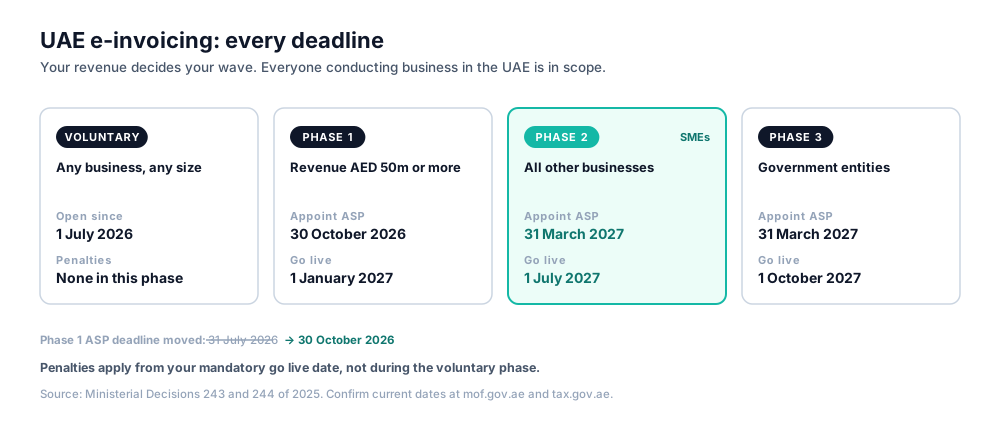
If your revenue is under AED 50 million, you must appoint an Accredited Service Provider by 31 March 2027 and go live on 1 July 2027. This applies whether or not you are registered for VAT. Larger businesses, those over AED 50 million, are ahead of you: their ASP window was 30 October 2026 and they go live on 1 January 2027, so expect bigger customers to be compliant before your own date. The real work is picking an accounting system that handles e-invoicing properly, cleaning up your customer and supplier data, and making sure your past filings are in order before the FTA can see everything.
Key facts
- Your deadlines: appoint an ASP by 31 March 2027, go live 1 July 2027
- You are in scope even if you are not VAT registered. You will need a Tax Identification Number from the FTA
- It covers invoices you send and bills you receive
- An ASP is a legal requirement, not a software upgrade you can skip
- The FTA will see transaction level data, so historic gaps become visible
Why this is bigger than a software change
It is tempting to file this under IT. It is not an IT problem.
Operationally, invoicing stops being something a person does and becomes something your system does. If your team raises invoices from a spreadsheet, or edits a PDF by hand, or turns a quote into an invoice through a chain of emails, that has to stop. Every invoice has to start life in a system that can produce structured data.
Legally, an invoice that fails validation is not a valid invoice. Your customer cannot reclaim the VAT on it. Expect larger customers, already live under Phase 1, to start rejecting non compliant invoices well before your own deadline. Your go-live date is not when this starts affecting you.
On compliance, this is the big one. Today the FTA sees quarterly totals. After go-live it sees every invoice you issue and every bill you receive, close to real time. Your sales ledger, your purchase ledger, your VAT return and your corporate tax return all have to tell the same story, because the authority can now check whether they do. Processes that rely on someone remembering to do something, or on a monthly tidy-up before filing, will not survive that.
Which leads to the practical point: automate it or it will not hold. Manual re-keying between an invoicing tool and your books introduces differences, and those differences are now visible. The businesses that come through this well are the ones where invoices, bills, ledger and returns all flow from one system without anyone retyping anything.
Strategically, you come out of this with clean, structured, near real time transaction data. That is the raw material for cash flow forecasting, margin analysis and a faster month end close. Treat it as a compliance tax to be minimised and you get the cost without the benefit.
Why you need an ASP, and what it does
The UAE has not built a government portal where you upload invoices. It uses accredited private providers to handle the exchange and report to the tax authority.
Your ASP does three things:
- Takes invoice data from your accounting system and converts it to the required format
- Validates it against the FTA's rules before it goes anywhere, catching errors at the point of issue instead of at audit
- Delivers it to your customer's ASP and reports the tax data to the FTA
You cannot send invoices to the FTA yourself, and you cannot send a structured invoice straight to your customer. The ASP is the plumbing.
The part most guidance misses: it works both ways
Almost everything written about UAE e-invoicing explains how you send an invoice. Half the change is on the other side.
Sending: your accounting system, to your ASP, to your customer's ASP, to your customer. Tax data goes to the FTA on the way.
Receiving: your supplier's system, to their ASP, to your ASP, into your accounting system.
Supplier bills will arrive as structured data, landing in your accounts payable. Not as a PDF someone forwards to the bookkeeper.
Done well this is an improvement. Bills arrive pre-coded, with no manual entry and no typos. Done badly, you end up with bills arriving through a channel nobody is watching while someone carries on keying in PDFs that are no longer valid.
This is the strongest argument for integration. A standalone ASP portal sitting outside your accounting system means a separate login to send invoices, a separate inbox for incoming bills, and manual re-entry at both ends. That is more work, not less.
How to approach this practically
Large businesses build custom links between their ERP and their ASP. For an SME that is neither affordable nor necessary. You have two sensible routes.
Route one: use an accounting system that is itself an accredited provider. Invoices are sent and received inside the system you already use. Nothing to integrate.
Route two: use an accounting system with a ready-made ASP integration. A little more setup, but fine, as long as the integration covers both sending and receiving.
What to avoid: a standalone ASP with no link to your books, or a custom build. Both cost more than they save at your scale.
Where some common systems stand
The table below is illustrative, not a recommendation or a complete list. It shows the kinds of arrangement available so you can work out which applies to you. Check the FTA's accredited provider list and the vendor's current terms before you decide anything.
| Your system | Typical position | What to do |
|---|---|---|
| Xero | E-invoicing capability offered at no extra cost at time of writing | Check it covers both sending and receiving, then enable |
| Wafeq | E-invoicing offered at no extra cost at time of writing | Check the scope and enable |
| Zoho | Operates as an accredited provider | Check your plan includes it |
| Odoo | Integrates with accredited providers such as Taxstar | Pick a provider and configure the link |
| Spreadsheets, or a system with no ASP route | Not viable | Move to a supported system |
That last row is the real decision for a lot of businesses, and it is better made now than in March 2027. If you are going to change accounting systems anyway, do it this year. Migrating your ledger and going live on e-invoicing in the same quarter is a painful way to spend a spring.
Clean up your past before the FTA can see it
Today the FTA sees summary figures on your VAT return. After go-live it sees the detail behind them.
That has an implication beyond e-invoicing itself.
If there are gaps in how your business has handled VAT or corporate tax historically, supplies treated inconsistently, input VAT claimed on things that never qualified, invoices missing required details, revenue booked in the wrong period, those patterns become much easier to spot going forward. And the contrast with what you filed before becomes visible.
Under the Tax Procedures Law the FTA can generally audit a tax period for five years after it ends, stretching to ten years where tax evasion or failure to register is involved.
So use the time before go-live to get your historic position reviewed and put right by someone qualified. Disclosing an error you found yourself puts you in a far better position than an assessment raised after the authority found it. This is the cheapest window you will get, and it closes on your go-live date.
A sensible sequence
- Now. Check whether you need a TIN. If you are not VAT registered, you are still in scope and will need to register with the FTA.
- Now. Audit your data. Pull your customer and supplier list. How many have a valid tax number recorded? A complete legal name and address? For most SMEs the honest answer is uncomfortable, and this is the work that takes months.
- Now. Review your historic tax position with a qualified adviser and fix what needs fixing while voluntary disclosure is still open to you.
- Q1 2027. Decide your system and provider. Change accounting systems if you need to.
- Q1 to Q2 2027. Adopt voluntarily and test. No penalty exposure during the voluntary phase. Use it.
- By 31 March 2027. Appoint your ASP formally.
- Before 1 July 2027. Confirm both directions work. Send a test invoice, receive a test bill, check both land correctly in your ledger.
How the system works, technically
For completeness. Most SMEs do not need this, because the ASP handles it.
The UAE uses a decentralised five corner model built on Peppol. The five corners are the seller, the seller's ASP, the buyer's ASP, the buyer, and the tax authority. Invoices travel in Peppol PINT-AE XML, an international standard with a UAE specific profile. The FTA's specification sets out 51 mandatory fields, including flags for free zone supplies, the margin scheme and deemed supply.
Sources
Primary documents are published by the UAE Ministry of Finance at mof.gov.ae and the Federal Tax Authority at tax.gov.ae, including the current list of Accredited Service Providers.
- Ministerial Decision No. 243 of 2025 (Electronic Invoicing System)
- Ministerial Decision No. 244 of 2025 (implementation and ASP appointment)
- Cabinet Decision No. 106 of 2025 (penalties)
- Federal Decree-Law No. 28 of 2022 on Tax Procedures
- UAE Ministry of Finance, Electronic Invoicing Guidelines
- Federal Tax Authority technical specification, February 2026
---
Last reviewed 4 November 2026. Confirm your position against current Federal Tax Authority guidance or speak to a licensed adviser before acting.
Related
- UAE E-Invoicing, Explained Without the Jargon
- The UAE VAT Survival Guide
- Small Business Relief extended to 2029
- Check your e-invoicing readiness
- E-invoicing readiness service
Speak to someone
Daira is a UAE licensed accounting and tax firm. We can review your historic VAT and corporate tax position, clean up your customer data, and get you onto a system that handles e-invoicing in both directions. Book a call
Topics
How Daira can help
Daira is a UAE licensed accounting and tax firm. If this is on your plate, these are the right next steps.