
Has UAE Small Business Relief been extended beyond 2026?
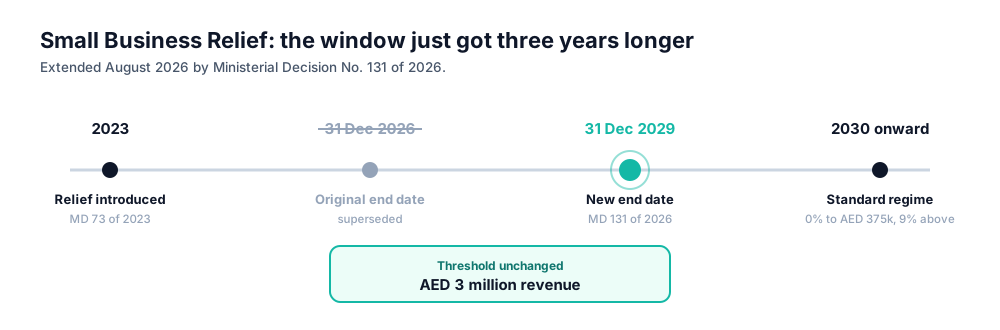
Yes. Small Business Relief now runs to tax periods ending on or before 31 December 2029, three years longer than planned. If your revenue is AED 3 million or less you pay no corporate tax, file a simplified return, and do not need to submit financial statements. You still have to register, file, and tick the box to claim it.
Key facts
What you get
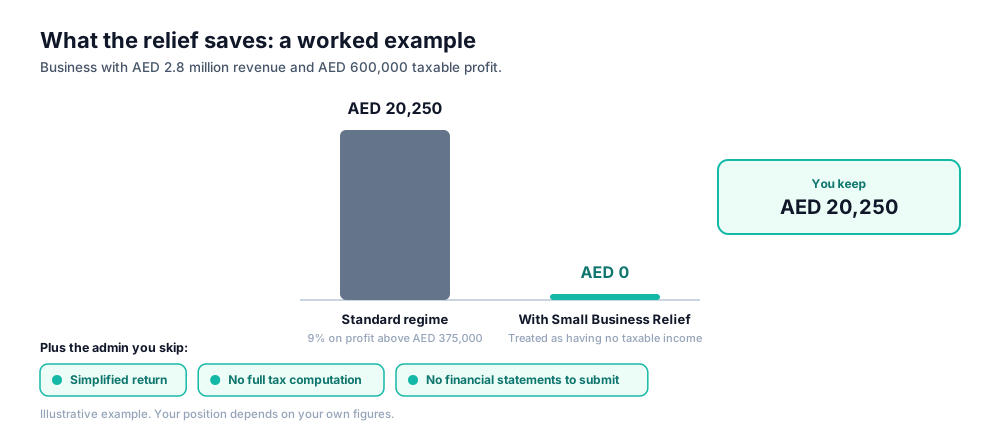
- No corporate tax to pay. Your business is treated as having no taxable income for the period.
- A simplified return. You are not working through the full corporate tax computation.
- No financial statements to submit with that return.
Who gets it
- Revenue of AED 3 million or less in the tax period, and in every previous period since the relief started
- UAE resident businesses only
- Not available to Qualifying Free Zone Persons or large multinational groups
How long
- Tax periods ending on or before 31 December 2029, extended from 31 December 2026
- Under Ministerial Decision No. 131 of 2026, announced August 2026
- The AED 3 million threshold has not changed
The catch
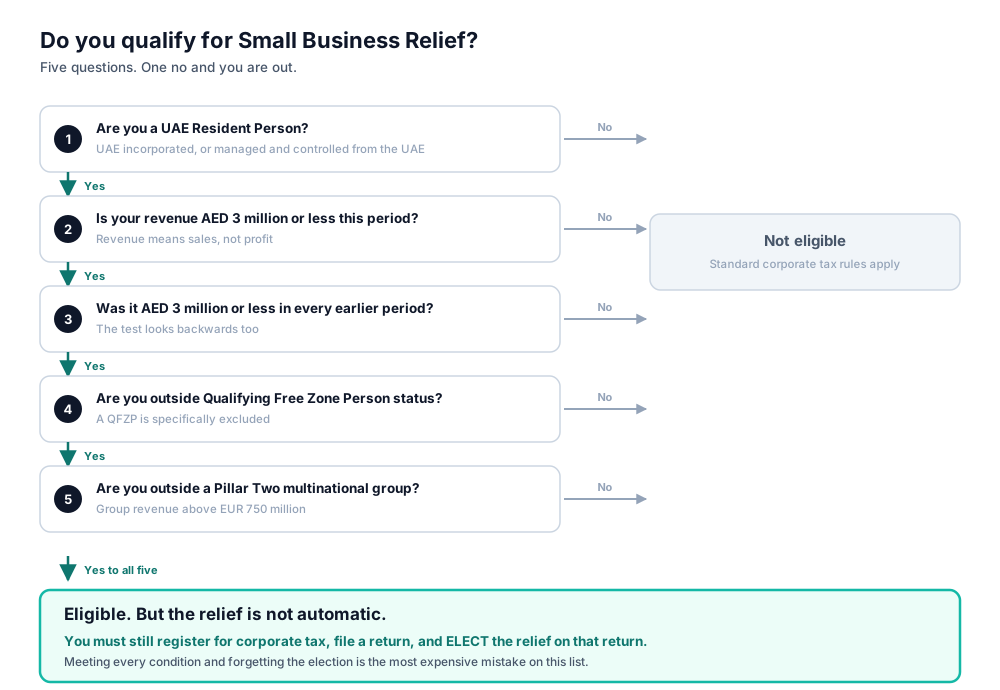
- It is not automatic. You must claim it on your return every year
- You must still register for corporate tax and file a return
This is good news, and the admin saving is the bigger half
Worth saying plainly, because the relief was due to expire and a lot of small businesses were bracing for a harder 2027.
The obvious benefit is the money. No corporate tax to pay for another three years.
The less obvious benefit is the paperwork, and for a small business it is worth more. With the relief you file a simplified return. You are not computing taxable income through the full set of adjustments. No exempt income analysis, no interest limitation calculation, no schedules of disallowed expenses. You do not have to submit financial statements with the return either.
For a ten person company with no finance team, that is weeks of work and a real advisory fee saved, every year, for three more years.
Who qualifies
All of these must be true for the tax period:
- You are a Resident Person, meaning a UAE incorporated company, or a foreign company managed and controlled from the UAE
- Your revenue is AED 3 million or less in the period
- Your revenue was AED 3 million or less in every earlier period since the relief became available
- You are not a Qualifying Free Zone Person
- You are not part of a large multinational group within scope of Pillar Two
Revenue is your sales, not your profit
This is the one people get wrong most often, so here are two examples.
Example 1. Qualifies. A marketing agency bills AED 2.6 million over the year and spends AED 2.4 million on salaries and costs. Profit is AED 200,000, which is thin. Revenue is AED 2.6 million, which is under the threshold. The agency qualifies.
Example 2. Does not qualify. A trading company sells AED 3.4 million of goods and spends AED 3.5 million buying and shipping them. It made a loss of AED 100,000. Revenue is AED 3.4 million, which is over the threshold. It does not qualify, even though it made no profit at all.
The test looks at what you sold, not what you kept.
Do not sleep through the next three years
The relief takes away your tax bill. It does not take away the need to keep proper books, and it runs out at the end of 2029.
Three years sounds like plenty. It is about 36 monthly closes. Businesses that use the time well move into the standard regime without drama. Businesses that treat it as permission to let the bookkeeping slide arrive at their first real corporate tax computation with three years of unreliable records behind them.
If you are making losses, talk to us before you claim
Small Business Relief interacts with how tax losses are treated, and that interaction matters if your business is not yet profitable.
Under the standard corporate tax rules, a loss is not wasted. It can generally be carried forward and set against profits in later years, reducing the tax you pay once you start making money. A loss today is worth something in the future.
How that works alongside a period in which you claimed Small Business Relief is a question with real money attached, and the answer depends on your specific position. You already pay nothing in a relief period, so claiming the relief gives you no extra benefit in a loss making year. What it may cost you is less obvious, and it only shows up years later.
The Federal Tax Authority publishes a Corporate Tax Guide on Small Business Relief, and Federal Decree-Law No. 47 of 2022 sets out the loss rules. Both are worth reading. Better still, if you are loss making and eligible, speak to us before you tick the box. For a startup burning cash in its early years the difference over five years can be material, and it is not a decision to make from a blog post.
Other things worth sorting now
Owner and director pay. How you account for what the owners take out, whether it is documented, and how it splits between salary, dividend and drawings. None of this costs you anything while the relief applies. All of it matters the moment you file under the standard rules. Fixing it while nothing depends on it is much easier than restructuring under scrutiny.
Transactions with related companies. If you buy from or sell to businesses under the same ownership, the pricing and documentation of those deals becomes important later. Set the position now.
When you record revenue. The AED 3 million test is a hard line, and which period a sale falls into can decide whether you qualify. Loose revenue recognition is a risk to the relief itself.
Fixed assets. A proper asset register with a consistent depreciation policy takes an afternoon to start and years to reconstruct.
Growing past AED 3 million. Once you cross the threshold you lose the relief, and because the test looks at earlier periods too, you cannot drop back under and claim it again. Plan the transition before you cross, not after.
What the relief does not remove
| Obligation | Still applies? |
|---|---|
| Corporate tax registration | Yes |
| Annual corporate tax return | Yes |
| Keeping accounting records | Yes |
| Record retention | Yes |
| VAT obligations, if registered | Yes, completely separate |
| E-invoicing from your go-live date | Yes, completely separate |
| Paying 9% corporate tax | No, for the period you claim |
| Submitting financial statements with the return | No |
Common mistakes
Mixing up revenue and profit. Eligibility is tested on sales. We regularly see businesses assume they qualify because they barely broke even, when turnover was well over AED 3 million.
Forgetting to claim it. You can meet every condition, file on time, and still be assessed under the standard rules because nobody made the election. The most expensive and most avoidable error on this page.
Not registering because no tax is due. Registration and filing are separate from whether you owe anything. Late registration penalties apply either way.
Assuming you can claim it again later. Go over AED 3 million once and you cannot come back, even if revenue falls.
Free zone companies assuming they are covered. A Qualifying Free Zone Person is specifically excluded. A free zone company that is not a QFZP may still qualify. Worth having checked rather than guessed.
Claiming it while loss making without taking advice. Covered above.
Letting the books slide for three years. The relief is a runway, not a holiday.
What happens after 2029
From the first tax period ending after 31 December 2029, eligible businesses move to the standard rules: 0% on taxable income up to AED 375,000 and 9% above that, with full filing requirements.
Whether there is another extension, nobody knows. Plan on the basis that there is not.
Sources
All of these are published by the UAE Ministry of Finance at mof.gov.ae and the Federal Tax Authority at tax.gov.ae.
- Ministerial Decision No. 131 of 2026, extending Small Business Relief
- Ministerial Decision No. 73 of 2023, setting the Small Business Relief conditions
- Federal Decree-Law No. 47 of 2022 on the Taxation of Corporations and Businesses
- Federal Tax Authority, Corporate Tax Guide on Small Business Relief
- UAE Ministry of Finance announcement, August 2026
---
Last reviewed 4 November 2026. UAE tax rules change. Confirm your position against current Federal Tax Authority guidance or speak to a licensed adviser before acting.
Related
- The UAE VAT Survival Guide
- UAE e-invoicing for SMEs
- How much does accounting cost in Dubai?
- Corporate Tax deadline checker
Speak to someone
Not sure whether you qualify, whether the election was made on your last return, or whether claiming is right if you are loss making? Daira is a UAE licensed accounting and tax firm. Book a call
Topics
How Daira can help
Daira is a UAE licensed accounting and tax firm. If this is on your plate, these are the right next steps.