
The 10 VAT rules every UAE business needs to know
UAE VAT is charged at 5%. Registration is mandatory once your taxable supplies exceed AED 375,000 in the past twelve months or are expected to in the next thirty days, and voluntary above AED 187,500. Returns are filed through EmaraTax, usually quarterly, within 28 days of the period end. Most penalties businesses incur come from late filing, poor records, or reclaiming input VAT they were never entitled to.
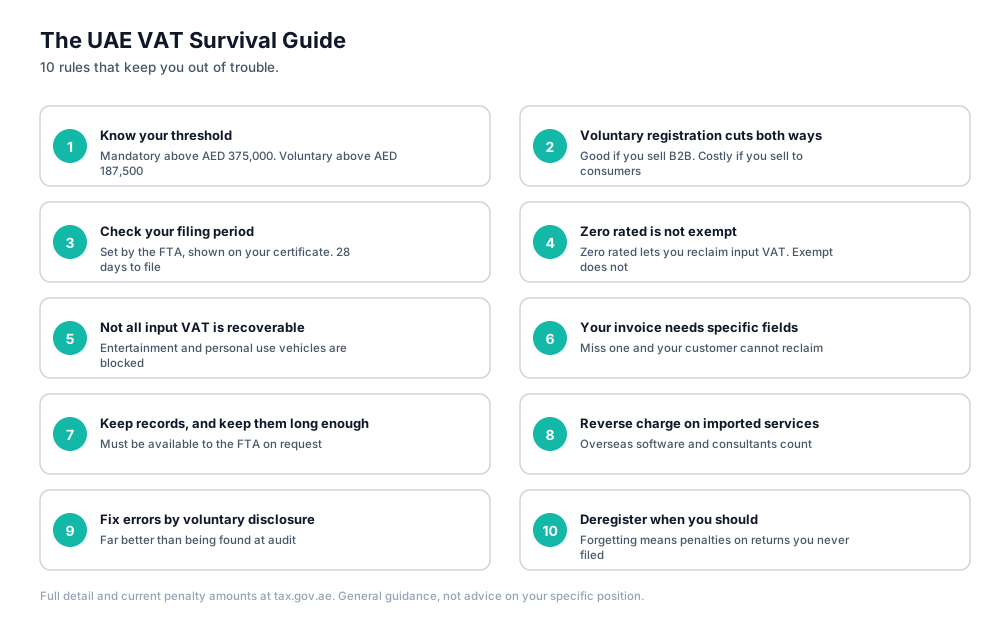
1. Know which threshold applies to you
Mandatory registration: taxable supplies and imports above AED 375,000 over the previous twelve months, or expected to go above it within the next thirty days.
Voluntary registration: taxable supplies or taxable expenses above AED 187,500.
Two things businesses get wrong. The twelve month test is rolling rather than tied to your financial year, so you can cross it mid year and the obligation starts right then. And the forward-looking test matters: if you sign a contract today that will take you over the threshold within thirty days, the obligation is triggered now, not when the invoice is raised.
Late registration carries a penalty, and it applies even where no VAT was ultimately collectible. Current amounts are set out in Cabinet Decision No. 49 of 2021, published by the Federal Tax Authority at tax.gov.ae. Check the current figure there rather than relying on a number you read elsewhere, because these have been amended.
2. Voluntary registration is sometimes worth it
If most of your customers are VAT-registered businesses and you incur significant input VAT, registering voluntarily lets you reclaim that input tax. The VAT you charge is recoverable by your customers, so it costs them nothing.
If you sell mainly to consumers, voluntary registration makes you 5% more expensive overnight. Model it before you opt in.
3. Your filing period is set by the FTA
Most businesses file quarterly. Larger businesses are assigned monthly periods. Your tax period is shown on your registration certificate, so check it rather than assuming.
Returns and payment are both due within 28 days of the period end. If the due date falls on a weekend or public holiday, it moves to the next working day.
Late filing and late payment are separate penalties, and late payment accrues over time. A business that files on time but pays late still has a problem. The current amounts for both sit in Cabinet Decision No. 49 of 2021 on the Federal Tax Authority site.
4. Understand zero-rated versus exempt, because they are not the same
This single distinction causes more VAT errors than anything else.
Zero rated supplies are taxable at 0%. You charge no VAT, and you can still recover the input VAT on related costs. Exports outside the GCC, international transport, certain healthcare and education, and the first supply of new residential property typically fall here.
Exempt supplies sit outside the VAT system. You charge no VAT and you cannot recover the input VAT on related costs. Certain financial services, residential property leases after the first supply, bare land and local passenger transport typically fall here.
If you make both taxable and exempt supplies you are partially exempt, and your input VAT must be apportioned. This is where SMEs most often get it wrong, usually by reclaiming everything.
5. Not all input VAT is recoverable
Even when you are fully taxable, some input VAT is blocked. Broadly, that means entertainment provided to anyone other than employees, motor vehicles available for personal use, and goods or services given to employees for their own benefit where you have no legal obligation to provide them.
The practical test is whether the cost is genuinely for the business. Client entertainment, staff cars used at weekends, and personal items run through the company are the recurring problem areas in every review we do.
6. Your tax invoice must contain specific information
An invoice missing required details is not a valid tax invoice, and your customer cannot use it to reclaim input VAT. You will hear about it from them.
A full tax invoice needs: the words "Tax Invoice", your name, address and TRN, the customer's name and address (and TRN where they are registered), a sequential invoice number, the date of issue and the date of supply if different, a description of the goods or services, the quantity and unit price, the amount payable in AED, the VAT rate and amount, and any discount.
A simplified tax invoice is available for supplies below a specified value, or to unregistered customers.
From your e-invoicing go-live date this changes again. PDFs stop being valid, and invoices must be issued as structured data through an accredited provider.
7. Keep records, and keep them long enough
You must keep records that support everything on your returns. Tax invoices issued and received, credit notes, import and export documentation, and your accounting records.
Retention periods are long, and longer again for real estate. Confirm the period that applies to your business and set your archiving policy accordingly.
Records must be available to the FTA on request. "The bookkeeper left and took the files" is not a defence.
8. Reverse charge applies to most imported services
When you buy services from a supplier outside the UAE, you generally account for the VAT yourself under the reverse charge. You declare the output VAT and, where it is recoverable, claim the same amount as input VAT in the same return.
Where you are fully taxable this nets to nil, which is exactly why it gets ignored. It still has to appear correctly on the return, and if you are partially exempt it does not net to nil at all.
Software subscriptions, overseas consultants, international advertising platforms and foreign professional fees are the common cases. Most SMEs under-declare here simply because no VAT appeared on the supplier's invoice.
9. Fix errors through voluntary disclosure
If you discover an error in a submitted return, there is a formal voluntary disclosure process. Thresholds and mechanics apply, so take advice on the right route.
The important point is behavioural. An error you find and disclose yourself is treated far more favourably than one the FTA finds at audit. The cost of disclosing is almost always lower than the cost of being caught, and the gap widens the longer the error sits.
This matters more from 2027, when e-invoicing gives the FTA transaction-level visibility.
10. Deregister when you should
If you stop making taxable supplies, or your supplies fall below the voluntary threshold, you must apply to deregister within a short window. Businesses that wind down and forget to deregister keep accruing filing obligations, and penalties for missing them.
The reverse is also true: do not deregister on a temporary dip if you expect to be back over the threshold.
The mistakes that come up again and again
- Registering late because the rolling twelve-month test was not being monitored
- Reclaiming input VAT on blocked items, particularly entertainment and vehicles
- Treating exempt supplies as zero-rated and over-reclaiming input VAT
- Ignoring reverse charge on overseas software and consultants
- Issuing invoices that lack required details, then being asked to reissue months later
- Filing on time but paying late
- Keeping records that cannot survive a request for supporting documentation
None of these are exotic. They are routine findings, and every one of them is avoidable.
Sources
All published by the Federal Tax Authority at tax.gov.ae, where you should check current penalty amounts directly rather than relying on figures quoted on third party sites.
- Federal Decree-Law No. 8 of 2017 on Value Added Tax
- Cabinet Decision No. 52 of 2017, the Executive Regulations, as amended
- Cabinet Decision No. 49 of 2021 on administrative penalties
- Federal Decree-Law No. 28 of 2022 on Tax Procedures
- Federal Tax Authority VAT guides and public clarifications
---
Last reviewed 4 November 2026. This is general guidance and not advice on your specific position. Confirm against current Federal Tax Authority guidance or speak to a licensed adviser.
Related
- VAT registration threshold checker: check whether you must register, may register, or should deregister
- E-Invoicing for UAE SMEs: Your 2027 Readiness Guide
- Small Business Relief extended to 2029
- How much does accounting cost in Dubai?
Speak to someone
Daira is a UAE licensed accounting and tax firm. We handle VAT registration, filing and reviews for SMEs across the UAE and Bahrain. Book a call
Topics
How Daira can help
Daira is a UAE licensed accounting and tax firm. If this is on your plate, these are the right next steps.