What is UAE e-invoicing, and what does it mean for my business?
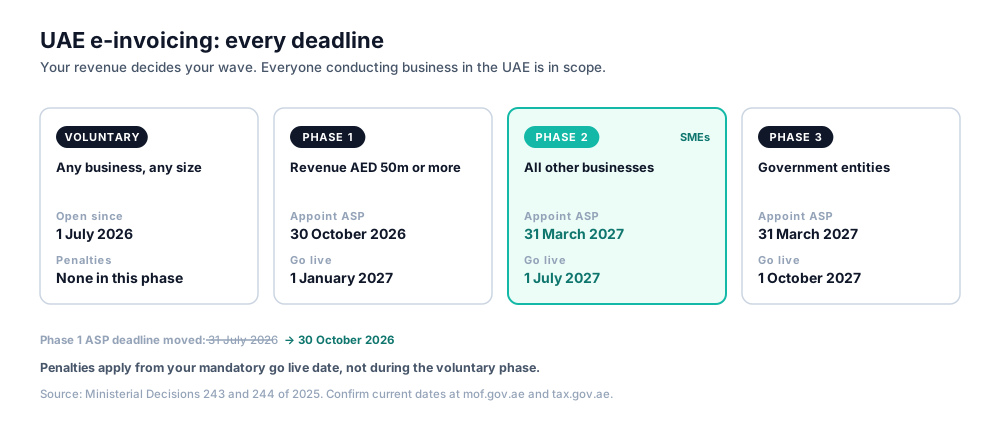
E-invoicing replaces the PDF invoice with a structured digital file that travels from your accounting system to your customer's through an accredited provider, with the tax data reaching the Federal Tax Authority automatically. It applies to anyone conducting business in the UAE, whether or not you are registered for VAT. The deadlines that carry penalties are the ASP appointment dates: 30 October 2026 if your revenue is AED 50 million or more, 31 March 2027 for everyone else.
Key facts
The deadlines that matter
| Your revenue | Appoint an ASP by | Go live |
|---|---|---|
| AED 50 million or more | 30 October 2026 | 1 January 2027 |
| Below AED 50 million | 31 March 2027 | 1 July 2027 |
| Government entities | 31 March 2027 | 1 October 2027 |
Missing the appointment date is what exposes you to penalties, because you cannot go live without a provider.
What changes: your invoices. Every invoice becomes a structured data file carrying the 51 mandatory fields the FTA has specified, issued through an accredited provider rather than emailed as a PDF.
Who is in scope: any person conducting business in the UAE, for every business transaction, regardless of VAT registration status, unless specifically excluded. Mainland and free zone. B2B and business to government. Sales to private individuals who are not acting in a business capacity are currently outside scope.
If you are not registered for VAT: you are still in scope, and you will need to register with the Federal Tax Authority to obtain a Tax Identification Number.
Legal basis: Ministerial Decisions 243 and 244 of 2025. Penalties under Cabinet Decision 106 of 2025.
How invoicing works today, and what replaces it
Right now the process is loose and nobody minds. You raise an invoice, save it as a PDF, email it. Someone at the other end prints it, keys it into their system, and files it. Three months later you add everything up into a VAT return. The FTA sees a set of totals. If it wants the detail behind them, it has to come and ask.
That changes completely.
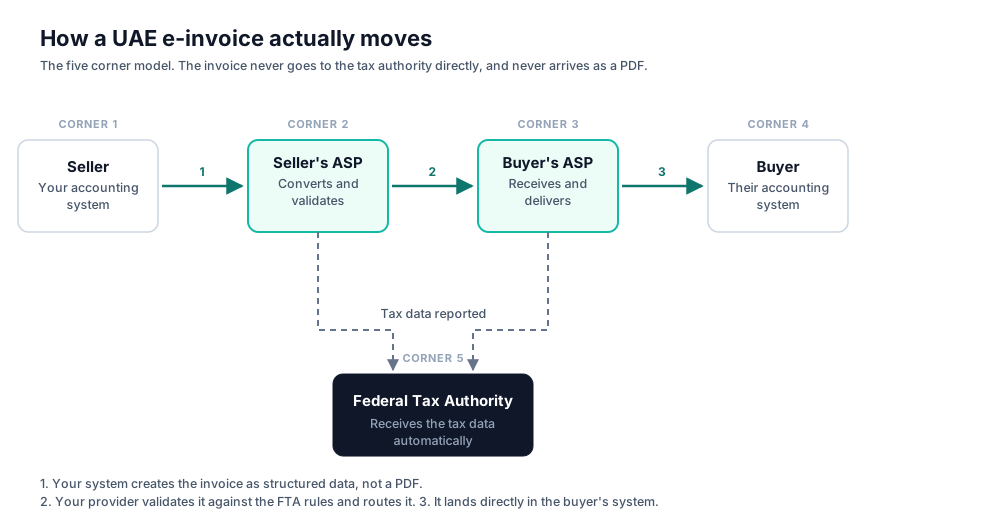
Your accounting system will produce the invoice as structured data. An accredited provider checks it against the FTA's rules, then delivers it to your customer's provider, which loads it straight into your customer's system. The tax data reaches the FTA in the same movement. Nobody emails anything. Nobody retypes anything.
Three things follow from this.
Your invoice data has to be right. The FTA has published a specification with 51 mandatory fields, covering invoice details, seller and buyer identification, and flags for things like free zone supplies, the margin scheme and deemed supply. A missing customer tax number used to be untidy. Now it stops the invoice going through.
You cannot do this yourself. Invoices move through Accredited Service Providers at both ends. Appointing one is a legal requirement.
It runs in both directions. Most coverage explains how you send an invoice. The same system governs the bills you receive. Supplier invoices will arrive in your system as structured data, not as PDFs in somebody's inbox.
What stops being valid
From your go-live date, these are no longer valid invoices for tax purposes:
- PDF invoices
- Scanned or photographed invoices
- Word and Excel documents
- Invoices typed into the body of an email
They cannot support an input VAT claim, and they cannot support a corporate tax expense deduction.
That is the real risk. A business still accepting PDF bills after its go-live date is building up costs it may not be able to deduct and VAT it may not be able to reclaim.
Why tax authorities are doing this
The old system asks you to add up your own numbers and send in a summary. The authority sees a handful of totals per quarter. If someone invents a supplier, inflates expenses, or simply does not declare half their sales, the only way to find out is an audit, years later, on a small fraction of businesses.
E-invoicing closes that gap. Every transaction is visible as it happens. A seller's invoice and a buyer's claim can be matched automatically, so a claim with no matching invoice stands out immediately.
Three things follow for honest businesses in the UAE.
The playing field levels. If your competitor has been winning work by not declaring income, that stops. You have been paying full tax and competing against someone who was not.
Filing gets easier over time. Once the authority already holds your transaction data, returns can be pre-filled. Several countries that went first now pre-populate VAT returns for taxpayers.
Your own data improves. Structured invoices in and out means your books reflect reality within days instead of weeks. That is the difference between knowing your margin now and finding out at year end.
This is a regional move, not a UAE one
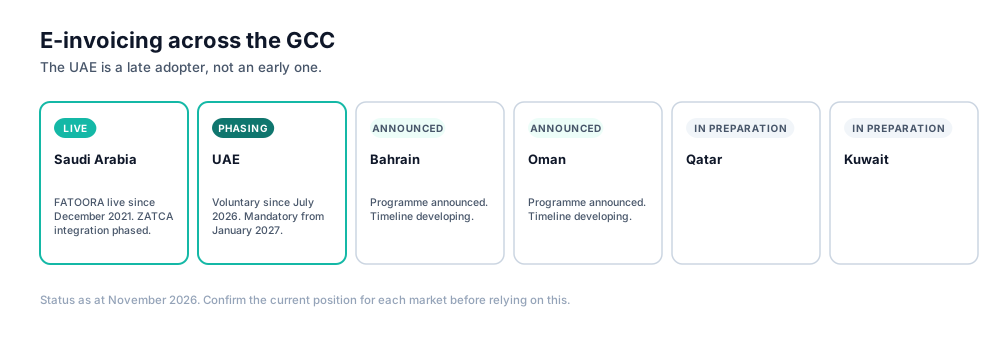
Saudi Arabia went first, launching FATOORA in December 2021 and phasing integration with ZATCA in waves ever since. It is the closest thing to a preview of where the UAE is heading.
The UAE is in its voluntary phase now, with mandatory waves through 2027.
Bahrain, Oman, Qatar and Kuwait are at various stages of announcement and preparation.
If you operate across more than one GCC market, you will face a version of this in each, on different timetables.
Outside the Gulf, the European Union's VAT in the Digital Age reforms, Italy, Poland, India and most of Latin America run comparable systems. This is becoming the global default.
Penalties
Penalties sit under Cabinet Decision No. 106 of 2025 and apply from your mandatory go-live date. They do not apply during the voluntary phase.
That makes the voluntary window genuinely useful. You can adopt early, discover that a third of your customer records have no valid tax number, fix it, and carry no penalty exposure while you do. Wait until your mandatory date and you find the same problems with the clock running.
What to do now
If your revenue is AED 50 million or more, your appointment deadline has passed and go-live is weeks away. If you have no provider, treat this as urgent.
If you are below AED 50 million, you have until 31 March 2027 to appoint and 1 July 2027 to go live. The work is in your data, not your software. Customer tax numbers, electronic addresses, invoice field mapping. Cleaning that up across a live customer base takes months.
If you are not VAT registered, check first whether you need to obtain a Tax Identification Number. Many businesses in this position do not realise they are in scope at all.
Common misunderstandings
"We are not VAT registered, so this does not apply." It applies regardless of VAT registration. This is the biggest single misreading, and it catches smaller businesses hardest.
"We are a free zone company." Free zone businesses are in scope.
"We are too small." Revenue decides your wave, not whether you are included.
"Our accounting software handles it." Your software has to produce the right data, but it must go through an accredited provider. Choosing software that is itself a provider, or integrates with one, makes this far simpler.
"We will deal with it nearer the time." The software is the easy part. The data is not.
Sources
Primary documents are published by the UAE Ministry of Finance at mof.gov.ae and the Federal Tax Authority at tax.gov.ae. Dates and technical requirements change, so check these directly.
- Ministerial Decision No. 243 of 2025 (Electronic Invoicing System)
- Ministerial Decision No. 244 of 2025 (implementation and ASP appointment)
- Cabinet Decision No. 106 of 2025 (penalties)
- UAE Ministry of Finance, Electronic Invoicing Guidelines
- Federal Tax Authority technical specification, February 2026
---
Last reviewed 4 November 2026. Confirm your position against current Federal Tax Authority guidance or speak to a licensed adviser before acting.
Related
- UAE e-invoicing for SMEs: what you must do before 31 March 2027
- Small Business Relief extended to 2029
- The UAE VAT Survival Guide
- Check your e-invoicing readiness
- E-invoicing readiness service
Speak to someone
Not sure whether you are in scope, or whether your invoice data is ready? Daira is a UAE licensed accounting and tax firm. Book a call
Topics
How Daira can help
Daira is a UAE licensed accounting and tax firm. If this is on your plate, these are the right next steps.